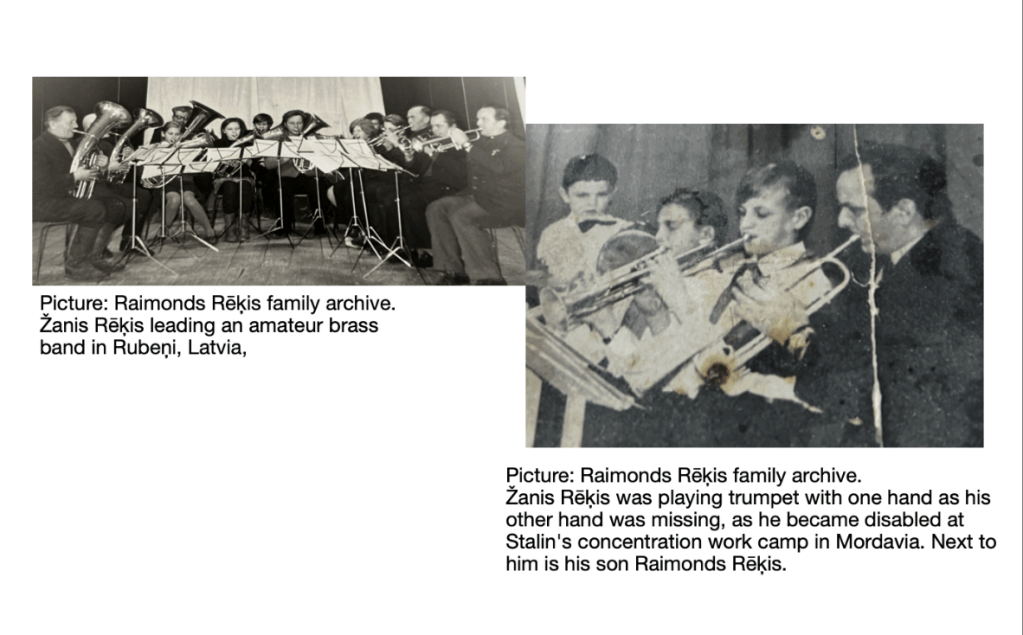
My grandfather, Žanis Rēķis, was a very inspiring role model, a survivor of Stalin’s concentration labor camp in Mordovia. He was an aspiring pianist, but at the age of seventeen, in tragic circumstances while being captured by Red Army soldiers, he became disabled. He lost one hand. After seven years in Mordovia carrying 50 lbs stones with one hand, he returned to his homeland, Latvia. He learned to play trumpet with one hand and taught an amateur brass ensemble in a very rural area, Rubeņi. Music became his way of reintegration into society, and he was a powerful role model for me to become a musician and educator. This example of how, even in tragic and severe circumstances, someone could find the will to survive and later work in the community as an educator inspired me.
Most of my family are teachers in four generations, and I was also exposed to general education strategies. Early in my education, I discovered that my musical talent and academic achievement served as a ticket to a better future, where resources would be less scarce. Playing the violin and winning competitions gave me both material and intrinsic awards, enabled me to enter an elite boarding school, and allowed me to travel around Latvia despite national economic hardship.
By 2009, I began studying for my bachelor’s degree at the Rotterdam Conservatory, and in 2013, I entered Boston University for a master’s degree with a full scholarship. I graduated with a Doctor of Musical Arts in violin performance from Boston University, with generous support from a College of Fine Arts School of Music scholarship and a School of Music stipend. I studied with Prof. Bayla Keyes.
I have worked as an educator since 2015, with extensive teaching experience in Greater Boston, as well as global experience. In 2025, I went to Moshi, Tanzania, as a volunteer teacher with Daraja Music Initiative, and I spent three weeks teaching violin, general music education, and nature conservation. It was a life-transforming experience reaching beyond music.
With teaching groups such as ensembles and orchestras, I have experience at the Josiah Quincy Elementary School’s Boston Music Project, Somerville Public School’s El Sistema program, and Brookline Public School’s after-school string program. I also have extensive online teaching experience. My six-part masterclass series sponsored by the US Embassy in Riga was attended by 200 participants in each session online. In 2025, I led a webinar for the Berklee Institute for Accessible Arts Education on Practical Strategies to Activate Music and SEL Skills Simultaneously in K-12 String Ensembles. I also gave an online webinar on the topic of performance anxiety for the Tonebase platform, and it has over three thousand views. I was also invited as a guest lecturer to lead two in-person workshops at Jazeps Vitols Latvian Academy of Music in Riga, Latvia, on the topic of performance anxiety and the transformational power of music. I also have a private violin studio, and I organize an annual performance for my students.
Through my extensive teaching, I have learned from my students that fostering belonging, compassion, and empathy is more and more important in our global society. I want my students to feel accepted and be able to make mistakes in the classroom, and to give them strategies for performance anxiety and emotional regulation through SEL. Moreover, I want to stand against the elitism where only select people who are guided by gatekeeping mechanisms prevent highly talented people from various backgrounds from entering the field of music and music education. I believe every child can learn and has to be given the opportunity.
There is a way for education to be accessible, serving the community, and having individualized learning plans. Education needs to develop critical thinking, leadership, and competence in skills that can foster confidence and inclusion in our global community. The socioeconomic challenges drive students to excel in their learning because they want to build a new positive peer group and community in these uncertain times, economically and politically.
 Aija Rēķe Violin Institute